From a London Drawing Room to a Global Community: The Physiological Society at 150
During 2026, the Physiological Society is celebrating its 150thanniversary — a remarkable milestone for the world’s oldest organisation dedicated to the science of physiology. Founded in London on the 31stMarch 1876, the Society has grown from a small gathering of pioneering scientists into one of the world’s leading organisations advancing our understanding of how living systems function. Throughout its history, the Society has helped shape modern physiology, championed scientific excellence, fostered international collaboration, and supported generations of physiologists.
The Society’s origins were born from both scientific ambition and necessity. During the mid-nineteenth century, experimental physiology was flourishing across continental Europe but remained in its infancy in Britain. William Sharpey, often described as the father of modern physiology in Britain, had begun transforming the discipline through his appointment to the Chair of General Anatomy and Physiology at University College London in 1836. Yet it was the debates surrounding the Royal Commission of Enquiry into Vivisection in 1875 that prompted physiologists to establish a unified voice for their discipline.
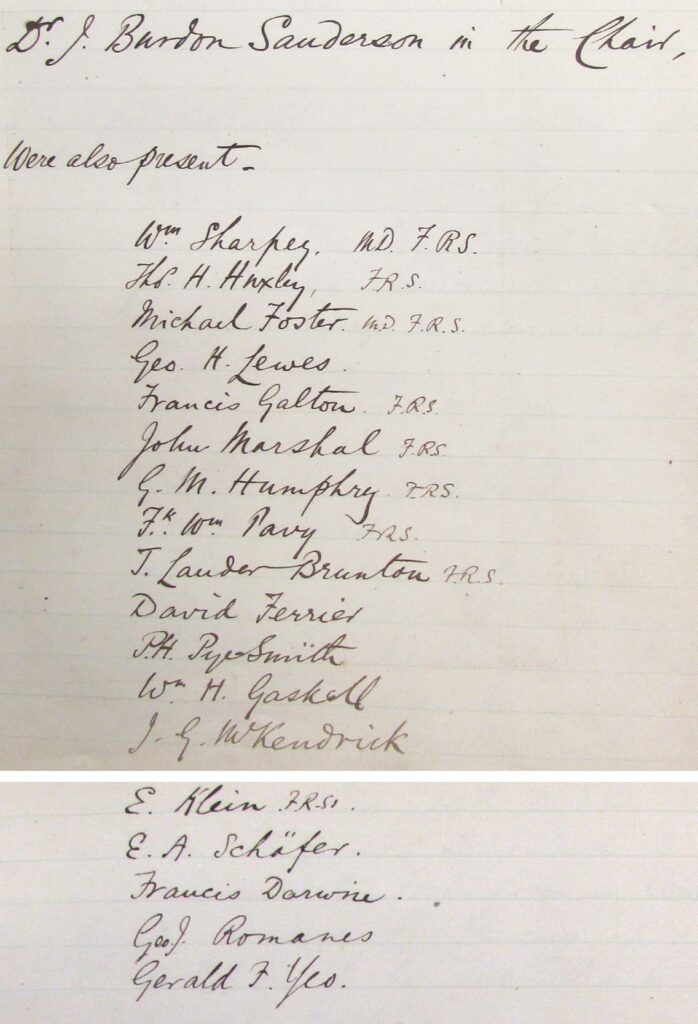
On the 31st March 1876, nineteen physiologists gathered at the London home of John Burdon-Sanderson and founded the Physiological Society with a clear purpose of: “promoting the advancement of physiology and facilitating the interaction between physiologists.” Among those present were many of the pioneers whose names remain synonymous with physiology today, including John Burdon-Sanderson in the chair, William Sharpey, TH Huxley, Michael Foster, Francis Galton, David Ferrier, Edward Schäfer, Gerald Yeo and Francis Darwin. Those early meetings combined scientific demonstrations with lively discussion and, famously, dinner. The Society quickly became known for its welcoming and informal atmosphere, creating a community where ideas could be exchanged freely. While it began as what many affectionately described as a “dining club”, it soon evolved into one of the world’s most influential scientific societies. As membership expanded beyond its original limit of forty members, the Society retained the collegial spirit that had characterised its earliest years whilst becoming increasingly representative of the growing discipline.
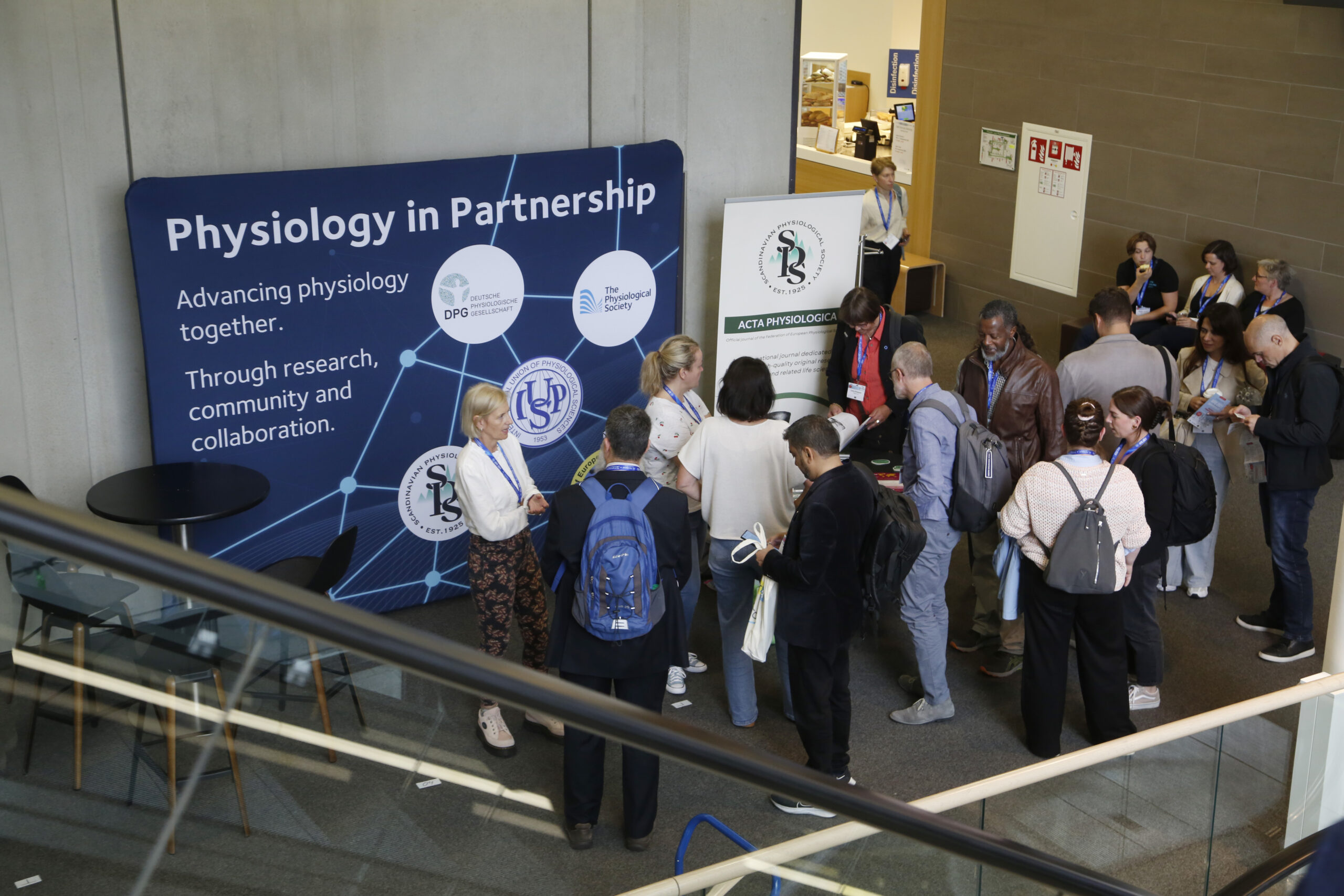
Within just a few years, the Society had established regular scientific meetings that became the model for many organisations that followed. In 1878, founder Michael Foster established The Journal of Physiology, which was acquired by the Physiological Society in 1926, a publication that remains one of the world’s leading journals in the field. Foster also played a central role in organising the first International Congress of Physiological Sciences in Basel Switzerland in 1889, helping to lay the foundations for the international physiological community that continues today through the International Union of Physiological Sciences (IUPS).
Publishing has remained central to the Society’s mission ever since. The Society’s publishing portfolio has evolved alongside the discipline itself. Experimental Physiology, founded in 1908 as the Quarterly Journal of Experimental Physiology, continues to publish research exploring physiological adaptation in health and disease and became fully Open Access in 2023. Recognising the increasingly collaborative nature of physiological research, the Physiological Society partnered with the American Physiological Society to launch Physiological Reports, a fully Open Access journal publishing high-quality research across the breadth of basic, translational and clinical physiology. These three journals are published through a partnership with Wiley.
Continuing its tradition of anticipating emerging scientific fields, the Society expanded its publishing portfolio again in 2024 through a partnership with Elsevier, launching two new journals. The Journal of Nutritional Physiology explores how nutrients interact with the body from the molecular to the whole-organism level, while The Journal of Precision Medicine: Health and Disease reflects the rapidly advancing field of personalised healthcare, publishing research that integrates physiology with genetics, environmental influences and lifestyle factors to improve prevention, diagnosis and treatment.
These five internationally recognised journals span the breadth of modern physiology. Together they push the boundaries of the discipline, promote excellence and best practice in research, and support the Society’s vision of a world in which physiological discovery leads to healthier lives.
As physiology expanded during the twentieth century, so too did the Society. Membership grew from just a few dozen scientists to well over 1,200 by its centenary in 1976, and today represents several thousand researchers, educators and clinicians working across every area of physiology. The Society has continually evolved to reflect the changing face of science. Women were first elected to membership in 1915, with pioneers such as Winifred Cullis paving the way for future generations. More recently, Professor Kim Barrett became the first female Editor-in-Chief of The Journal of Physiology in 2015, while Professor Bridget Lumb became the Society’s first female President in 2018, reflecting the Society’s continuing commitment to equality, diversity and inclusion.
The Society’s activities have expanded well beyond publishing and scientific meetings. Today it supports physiologists throughout their careers, promotes physiology education, influences science policy, engages with the public, recognises excellence through internationally respected prize lectures and awards, and advocates for physiology’s role in addressing global health challenges. Recent initiatives have included parliamentary engagement on healthy ageing and sport and exercise science, support for members during the COVID-19 pandemic, the launch of its Blue Plaque scheme celebrating pioneering physiologists, and the Global Climate and Health Summit, bringing together scientists, policymakers and health professionals to address one of the defining challenges of our time. A particularly significant milestone during this 150th anniversary year is the award of a Royal Charter. Granted by His Majesty the King, the Charter formally recognises the Society’s pre-eminence and unique role within the UK and international scientific landscape, alongside our outstanding contribution to science and the public good over the past century and a half: it marks a new chapter in its distinguished history.
The Society’s 150thanniversary is both a celebration of its rich history and an opportunity to look forward. Throughout 2026, a year-long programme of events is bringing physiologists together across the United Kingdom, Ireland and internationally. The celebrations began close to the Society’s founding date with a Lab Lunch Week, when members across the world gathered to celebrate 150 years of physiology while reflecting on the future of the discipline. A new 150 Voices project is capturing the memories of members past and present through audio and video interviews, preserving personal stories alongside the Society’s historical archives.
During this year a series of regional scientific meetings linked to the Society’s prestigious prize lectures is taking place across England, Scotland, Wales, Northern Ireland and the Republic of Ireland. But the programme began internationally in Milan, where physiologists celebrated the unveiling of a Blue Plaque honouring the renowned Italian physiologist, Rodolfo Margaria. This was twinned with a scientific meeting “Lavori in corso” (Work in Progress) 2026 about ‘Current Research in Exercise Physiology’.
To create a lasting scientific legacy, abstracts presented during the anniversary celebrations will be published in a special 150th Anniversary Abstract Book, providing a permanent snapshot of physiological research in 2026. The anniversary programme will culminate in Advancing Physiology Together, which will showcase the breadth, ambition, and impact of research from Early- and Mid-Career Physiologists across the globe and throughout all areas of physiology.
The celebrations will also extend beyond the scientific community. In October, the Society will host a major 150th anniversary reception and Showcase Physiology in the Houses of Parliament, bringing together parliamentarians, policymakers, researchers and partners to demonstrate the impact of physiology on health, medicine and public policy. The event reflects a tradition dating back to the Society’s foundation in 1876, when physiologists first came together to ensure that scientific discovery was represented within the policy landscape.
Reflecting on the Society’s first fifty years in 1926, founder Edward Sharpey-Schafer expressed confidence that future generations would continue the work begun in 1876. Looking back from 2026, that confidence was well placed. Physiology has transformed beyond anything the founders could have imagined, yet their original vision remains remarkably relevant. Scientific discovery continues to flourish through collaboration, curiosity and the sharing of knowledge.
One hundred and fifty years after nineteen physiologists gathered in a London drawing room, the conversation they began continues across laboratories, universities and research institutes around the world. Through its journals, scientific meetings, international collaborations and support for physiologists at every career stage, the Physiological Society continues to foster discovery and facilitate collaboration. As it celebrates its 150th anniversary, the Society looks forward to working with colleagues across the global physiological community to ensure that physiology continues its vital contribution to improving health and wellbeing for generations to come.
Further reading
- Sharpey-Schafer E (1927). History of the Physiological Society during its First Fifty Years, 1876-1926. Part.1. J.Physiol 64 (Suppl), 1–76.
- Sharpey-Schafer E (1927). History of the Physiological Society during its First Fifty Years, 1876-1926. Part 2. J Physiol 64 (Suppl), 77–181.
- Bynum WF (1976). A Short History of The Physiological Society. J. Physiol 263, 23-72.